zclaw
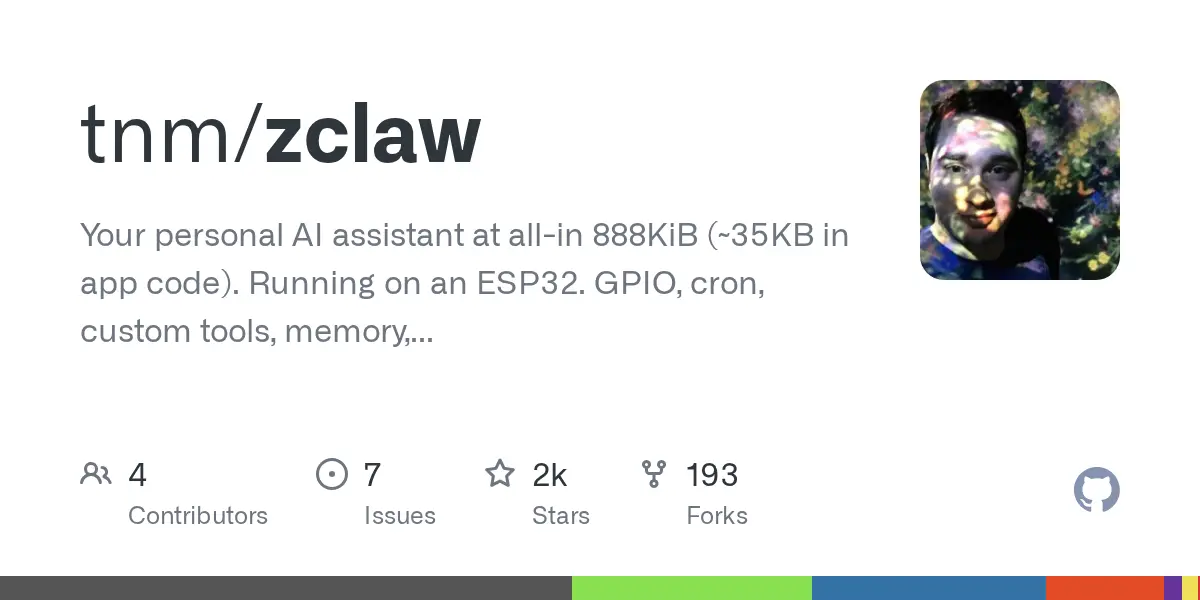
zclaw is written in C and runs on ESP32 boards with a strict all-in firmware budget target of 888 KiB or less on the default build.
- Hardware:
- ESP32
- Difficulty:
- Intermediate · Our suggestion
- License:
- MIT
- Creator:
- tnm
The smallest possible AI personal assistant for ESP32
By tnm
- Posted
What it does
zclaw is written in C and runs on ESP32 boards with a strict all-in firmware budget target of 888 KiB or less on the default build. It supports scheduled tasks, GPIO control, persistent memory, and custom tool composition through natural language.
- Scheduled tasks, GPIO control, persistent memory, and custom tool composition through natural language.
- The 888 KiB cap is all-in firmware size: zclaw logic plus ESP-IDF/FreeRTOS runtime, Wi-Fi/networking, TLS/crypto, and cert bundle.
- Chat via Telegram or a hosted web relay, with timezone-aware schedules (daily, periodic, and one-shot once).
- GPIO, DHT, and I2C control with guardrails, and persistent memory across reboots.
- A USB local admin console for recovery, safe mode, and pre-network bring-up.
What you need
- Difficulty
- Intermediate · Our suggestion
- License
- MIT (source)
Parts
- ESP32 board: ESP32, ESP32-C3, ESP32-S3 or ESP32-C6
- Seeed XIAO ESP32-C3 [optional]
- AI model or service
- Anthropic, OpenAI, OpenRouter or Ollama (custom endpoint) (source)
Prices, notes and sources: Parts and requirements
Parts and requirements
| Part | Spec / notes | Needed | Price |
|---|---|---|---|
| ESP32 board: ESP32, ESP32-C3, ESP32-S3 or ESP32-C6 | Classic ESP32-WROOM/ESP32 DevKit boards are supported | Required | |
| Seeed XIAO ESP32-C3 | Recommended starter board | Optional |
- WiFi credentials and an LLM backend, model and API key (or an Ollama API URL), provisioned with ./scripts/provision.sh
- A Telegram token and chat ID allowlist, to chat via Telegram
Steps
- Difficulty
- Intermediate · Our suggestion
- Run the bootstrap script, or ./install.sh in a clone
- Flash the firmware (secure mode encrypts credentials in flash)
- Provision WiFi and LLM credentials with ./scripts/provision.sh
- Send a test message through ./scripts/web-relay.sh
Full instructions: View original
How it works
The firmware runs on the ESP32 and you chat with it over Telegram or a hosted web relay. It calls an LLM backend (Anthropic, OpenAI, OpenRouter, or Ollama at a custom endpoint) using WiFi and LLM credentials provisioned with ./scripts/provision.sh.
| Layer | Component | Runs on |
|---|---|---|
| Firmware | zclaw (C, with ESP-IDF/FreeRTOS) | ESP32, ESP32-C3, ESP32-S3 and ESP32-C6 |
| Chat | Web relay (hosted relay + mobile chat UI) | ./scripts/web-relay.sh |
| LLM | LLM backend, model and API key (or Ollama API URL) | Provider APIs, or your Ollama API URL |
Setup effort
Run the one-line bootstrap or ./install.sh, flash, then provision WiFi and LLM credentials with ./scripts/provision.sh.
Limits and caveats
- Default LLM rate limits are 100/hour and 1000/day; changing them is a compile-time edit in main/config.h.
- Tested targets are ESP32, ESP32-C3, ESP32-S3 and ESP32-C6; test reports for other variants are welcome.
Like this build? Get the weekly builds
Every Thursday: the 5 best gadget hacks you can copy. Free.
Built something? Submit a build
The creator's config
Copied word for word from the creator's repository, at the commit linked in each source.
Local admin console (USB serial)
./scripts/monitor.sh /dev/cu.usbmodem1101
# then type:
/wifi status
/wifi scan
/bootcount
/gpio all
/reboot
Use-case ideas
- Scheduled tasks, GPIO control and custom tools, set up through natural language.
Why it's interesting
zclaw calls itself the smallest possible AI personal assistant for ESP32. It is written in C with a strict all-in firmware budget target of 888 KiB, and that cap includes not just the zclaw logic but the ESP-IDF/FreeRTOS runtime, Wi-Fi and networking, TLS and crypto, and the cert bundle. The README’s size breakdown puts the app logic at about 38.4 KiB, roughly 4.6% of the image. You chat with it over Telegram or a hosted web relay, and it keeps persistent memory across reboots, runs timezone-aware schedules and controls GPIO, DHT and I2C with guardrails. Providers include Anthropic, OpenAI, OpenRouter and Ollama, and a USB local admin console works for recovery even without Wi-Fi or an LLM. Tested targets are the ESP32, ESP32-C3, ESP32-S3 and ESP32-C6, and the recommended starter board is the Seeed XIAO ESP32-C3.
Source: github.com/tnm/zclaw#readme
Hardware
- ESP32
Credits and links
This page is a short summary written by HardwareLab. Build steps, code and photos belong to the creator; follow “View original” for the full project.
Featured? Add this badge
Built this? Paste the badge into your README. It links back to this page.

Markdown
[](https://hardwarelab.dev/projects/zclaw/?utm_source=badge&utm_medium=referral&utm_campaign=launch_2w)HTML
<a href="https://hardwarelab.dev/projects/zclaw/?utm_source=badge&utm_medium=referral&utm_campaign=launch_2w"><img src="https://hardwarelab.dev/badge.svg" alt="Featured on HardwareLab" width="188" height="20"></a>Related builds
All 23 in Local LLM Rigs & Edge Agents
ESP32 iPhone Agent
An ESP32-S3 board lets an AI model use a real iPhone: no computer at run time, no jailbreak.
- Seeed XIAO ESP32S3 (plain, 8MB PSRAM; any ESP32-S3 with native USB + PSRAM)
- iPhone on iOS 18+ with cellular data
- Lightning to USB Camera Adapter (Lightning iPhones only)
- +2 more
Intermediate4.8K
Muse Gadgets SDK
Meta’s open SDKs for connecting Muse to ESP32 and Raspberry Pi gadgets.
- ESP32 boards
- Raspberry Pi (3B+, 4, 5 or Zero 2 W) or another Linux computer with Bluetooth LE
Intermediate2.7K
Needle 2 ESP32
45M-parameter LLM offline on an ESP32-S3 turning English into valid commands.
- ESP32-S3
Advanced209
ESP32s3 LLM Cluster
Seven ESP32-S3s daisy-chained to run a 0.5B ternary LLM.
- 7x ESP32-S3 over SPI
Advanced259
Sources
- github.com/tnm/zclaw/blob/e3ad271244c1f2e01f4df6e81c2bab346e95d1b1/README.md?plain=1#L12
- github.com/tnm/zclaw/blob/e3ad271244c1f2e01f4df6e81c2bab346e95d1b1/README.md?plain=1#L14-L15
- github.com/tnm/zclaw/blob/e3ad271244c1f2e01f4df6e81c2bab346e95d1b1/README.md?plain=1#L69-L70
- github.com/tnm/zclaw/blob/e3ad271244c1f2e01f4df6e81c2bab346e95d1b1/README.md?plain=1#L74-L76
- github.com/tnm/zclaw/blob/e3ad271244c1f2e01f4df6e81c2bab346e95d1b1/README.md?plain=1#L75
- github.com/tnm/zclaw/blob/e3ad271244c1f2e01f4df6e81c2bab346e95d1b1/README.md?plain=1#L138-L144
- github.com/tnm/zclaw/blob/e3ad271244c1f2e01f4df6e81c2bab346e95d1b1/README.md?plain=1#L82-L83
- github.com/tnm/zclaw/blob/e3ad271244c1f2e01f4df6e81c2bab346e95d1b1/README.md?plain=1#L86
- github.com/tnm/zclaw/blob/e3ad271244c1f2e01f4df6e81c2bab346e95d1b1/README.md?plain=1#L58-L59
- github.com/tnm/zclaw/blob/e3ad271244c1f2e01f4df6e81c2bab346e95d1b1/README.md?plain=1#L82
- github.com/tnm/zclaw/blob/e3ad271244c1f2e01f4df6e81c2bab346e95d1b1/README.md?plain=1#L126
- github.com/tnm/zclaw/blob/e3ad271244c1f2e01f4df6e81c2bab346e95d1b1/README.md?plain=1#L59
- github.com/tnm/zclaw/blob/e3ad271244c1f2e01f4df6e81c2bab346e95d1b1/README.md?plain=1#L33-L61
- github.com/tnm/zclaw/blob/e3ad271244c1f2e01f4df6e81c2bab346e95d1b1/README.md?plain=1#L60
- github.com/tnm/zclaw/blob/e3ad271244c1f2e01f4df6e81c2bab346e95d1b1/README.md?plain=1#L82-L84